
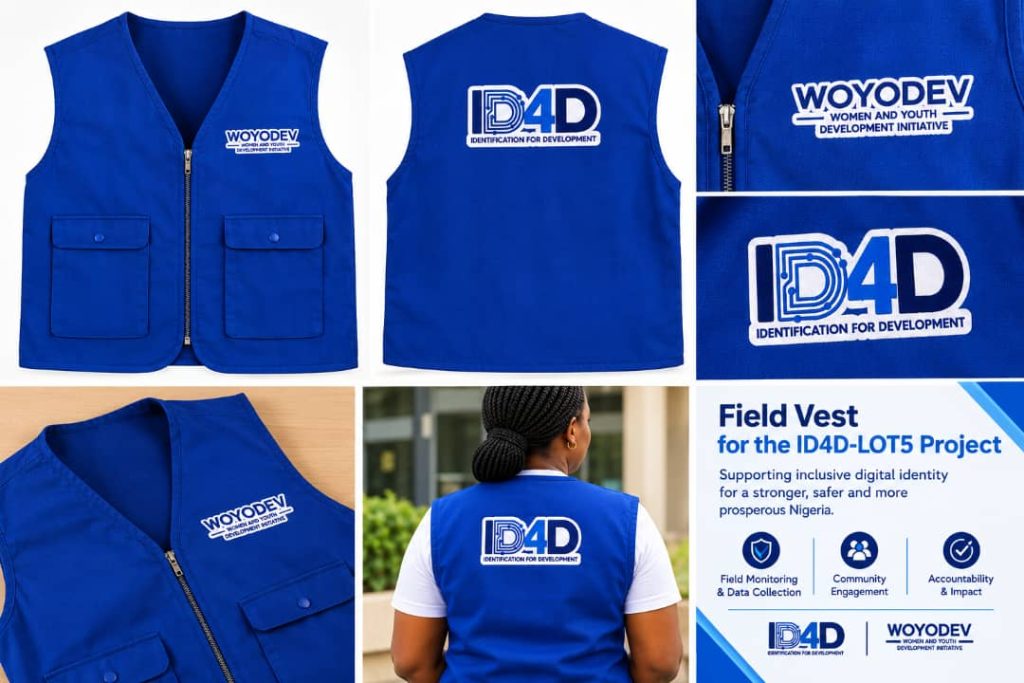
Through its LOT 5 assignment under Nigeria’s Digital Identification for Development (ID4D) Project, WOYODEV will undertake independent, evidence-based monitoring of enrolment activities, service delivery and beneficiary experiences across Bayelsa and Cross River States.
Yenagoa/Calabar, Nigeria | 2026
As Nigeria continues to advance its foundational digital identification system, ensuring that enrolment services are accessible, reliable, transparent and responsive to the needs of diverse population groups remains essential. The Women Environment and Youth Development Initiative (WOYODEV) has commenced implementation of its Third-Party Monitoring (TPM) assignment under the Nigeria Digital Identification for Development (ID4D) Project, covering Bayelsa and Cross River States under LOT 5.
The assignment will provide independent, systematic and evidence-based monitoring of digital identity registration and enrolment activities, with particular attention to service delivery, operational performance, accessibility, data quality and the experiences of people seeking to obtain their National Identification Number (NIN).
Through field-based verification, community engagement, beneficiary feedback and structured data collection, WOYODEV aims to generate credible evidence that can help identify implementation gaps, document operational challenges and inform practical improvements in the delivery of foundational identification services. The assignment forms part of the broader Nigeria ID4D Project, implemented by the National Identity Management Commission (NIMC) with support from development partners, including the World Bank.
Why Inclusive Digital Identification Matters
A recognised identity is an important foundation for participation in an increasingly digital society. It can help people establish their identity and facilitate access to public services, financial services and other opportunities for which recognised identification is required.
However, the value of a national identification system extends beyond the number of people enrolled. Its effectiveness also depends on whether registration services are accessible, whether enrolment processes operate as intended, whether people receive appropriate information and assistance, and whether implementation responds to the circumstances of different population groups.
For people living in underserved communities, older persons, women and persons with disabilities, barriers to accessing registration services may affect their ability to participate fully in the identification system. Geographical distance, physical accessibility, information gaps, operational difficulties and other service delivery challenges can influence people’s experiences of enrolment.
Understanding these experiences requires more than administrative reporting. It requires systematic observation, verification and meaningful engagement with the people and communities that interact with the system.
This is where independent monitoring can make an important contribution.
By examining implementation practices and documenting beneficiary experiences, Third-Party Monitoring can provide an additional source of evidence on how services are delivered, where challenges arise and what practical changes may improve accessibility and service quality.
For WOYODEV, the ID4D–LOT 5 assignment provides an opportunity to apply its commitment to inclusive development, community engagement and evidence-based monitoring to an important component of Nigeria’s digital development agenda.
WOYODEV’s Role in the ID4D–LOT 5 Assignment
Under LOT 5, WOYODEV is responsible for conducting Third-Party Monitoring activities in Bayelsa and Cross River States.
The assignment focuses on independently assessing registration and enrolment activities, verifying reported implementation information against field observations and available records, and gathering feedback from beneficiaries and relevant stakeholders.
Monitoring will examine the conditions under which enrolment services are delivered, including the availability and functionality of relevant infrastructure and equipment, the accessibility of enrolment locations, operational processes and the experiences of people using these services.The assignment will also seek to identify good practices, document implementation challenges and develop evidence-informed recommendations that can support corrective action and continuous improvement.
A central consideration is whether enrolment arrangements adequately account for the needs of different population groups, including women, young people, older persons and persons with disabilities.
Through this approach, WOYODEV aims to contribute to a clearer understanding of implementation performance across the two states while ensuring that beneficiary experiences remain an important part of the monitoring process.
The objective is not simply to establish whether activities are taking place, but to generate credible evidence about how enrolment services are functioning, the challenges people encounter and the improvements that may be needed.
From Field Evidence to Better Service Delivery
WOYODEV will implement a structured monitoring approach combining quantitative and qualitative methods to examine enrolment activities and understand the experiences of beneficiaries.
The approach will include five complementary components.
- Field Visits and Physical Verification
Monitoring teams will visit selected enrolment locations in Bayelsa and Cross River States to observe service delivery, verify site conditions and assess the availability and functionality of relevant infrastructure and equipment.
These visits will help establish whether reported implementation conditions correspond with field observations and identify operational issues that may affect the delivery of enrolment services.
Physical verification will also provide an opportunity to document good practices and areas requiring further attention.
- Community Engagement and Stakeholder Consultations
Understanding service delivery requires engagement with people beyond the immediate enrolment environment.
WOYODEV will engage community stakeholders and facilitate discussions to understand local experiences, service delivery challenges and opportunities for improvement.
Engagement will include older men and women, male and female youth groups, and persons with disabilities within these groups.
These consultations will help bring community perspectives into the monitoring process and provide context for understanding the barriers people may encounter when seeking identification services.
- Beneficiary Feedback and Exit Interviews
The experiences of people who use enrolment services are an important source of evidence for assessing service quality and accessibility.
Through beneficiary feedback and exit interviews, WOYODEV will gather information on people’s experiences of the enrolment process, including the accessibility of services, information provided, interactions with enrolment personnel and concerns arising during registration.
This approach will help identify issues that may not be fully reflected in administrative records alone.
It will also provide a structured means of documenting beneficiary perspectives and identifying opportunities to make enrolment services more responsive to people’s needs.
- Digital Data Collection and Quality Assurance
Reliable monitoring depends on the quality and consistency of the evidence collected.
WOYODEV will use digital data collection tools, including KoboToolbox-based forms, to support structured information gathering, data validation and timely reporting.
Quality assurance measures will include supervisory checks, data review, verification and back-checks where appropriate.
These processes are intended to strengthen the reliability of monitoring findings and support the preparation of evidence-based reports.
- Inclusion and Accessibility Assessment
An identification system can only serve its intended purpose when people are able to access and use its services.
WOYODEV will therefore examine potential barriers affecting access to enrolment facilities and processes, with particular attention to women, persons with disabilities, underserved communities and other groups that may experience difficulties accessing identification services.
The monitoring process will seek to identify accessibility concerns, information gaps and other implementation challenges that may affect participation.
By documenting these issues, WOYODEV aims to contribute evidence that can inform improvements in service delivery and support more inclusive access to foundational identification services.
Why Independent Monitoring Matters
Effective project implementation requires dependable information about what is happening on the ground.
Administrative reports provide important information on activities and outputs, but field verification and direct engagement with beneficiaries can offer additional perspectives on implementation performance.
Independent monitoring brings these sources of evidence together to provide a more complete understanding of service delivery.
Under ID4D–LOT 5, WOYODEV’s monitoring work will contribute to this process by examining reported implementation information, observing enrolment conditions, documenting beneficiary feedback and identifying challenges requiring attention.
This approach can help distinguish between activities that have been reported and conditions that have been independently observed. It can also help identify differences in implementation experiences across locations and population groups.
The resulting findings and recommendations are intended to support informed decision-making, strengthen accountability and identify practical opportunities for improvement.
For WOYODEV, accountability means making implementation more visible through evidence, while inclusion requires paying attention to whose experiences are reflected in that evidence and whose barriers might otherwise remain overlooked.
Putting Communities at the Centre of Monitoring
Community engagement is an important element of WOYODEV’s approach to the assignment.
People seeking identification services experience the enrolment process directly. Their perspectives can help explain why particular challenges arise, how these challenges affect access and what changes may improve their experience.
Engaging different population groups is therefore important for understanding the practical realities of service delivery.
The inclusion of older persons, women, young people and persons with disabilities in stakeholder engagement activities will help broaden the perspectives considered during monitoring.
Such engagement is particularly relevant when assessing whether enrolment arrangements are accessible to people with different physical, social and geographical circumstances.
WOYODEV recognises that meaningful monitoring requires careful attention to the information people provide and responsible handling of the information collected.
The organisation is committed to conducting its assignment professionally, maintaining the integrity of its monitoring processes and treating beneficiaries and stakeholders with respect.
Through this approach, community perspectives will contribute to a broader evidence base for understanding enrolment implementation across Bayelsa and Cross River States.
Expected Contribution to Nigeria’s Digital Identification Agenda
Through the ID4D–LOT 5 assignment, WOYODEV seeks to contribute to a stronger evidence base for assessing the implementation of digital identification enrolment activities.
The monitoring process is expected to support:
- Greater implementation visibility: Improved understanding of enrolment activities and conditions across selected locations in Bayelsa and Cross River States.
- Stronger verification: Independent field evidence to help assess reported implementation information.
- Improved understanding of operational challenges: Documentation of service delivery gaps, infrastructure concerns and other issues affecting enrolment activities.
- Greater attention to inclusion: Identification of barriers that may limit access to registration services for underserved groups.
- More systematic beneficiary feedback: Structured documentation of people’s experiences, concerns and suggestions.
- Stronger data quality: Application of digital data collection, verification and quality assurance procedures.
- Evidence-informed recommendations: Practical findings to inform implementation improvements and corrective action where necessary.
- Continuous improvement: Additional evidence to support accountability, transparency and responsiveness within the digital identification ecosystem.
These are intended contributions of the monitoring assignment. Their realisation will depend on the findings generated, the challenges identified and the extent to which relevant recommendations inform subsequent action.
Ultimately, the broader objective is to support the development of a foundational identification system that is reliable, accessible and responsive to the needs of Nigeria’s diverse population.
WOYODEV’s Commitment to Accountable and Inclusive Development
The ID4D–LOT 5 assignment reflects WOYODEV’s continuing commitment to community-centred development, social inclusion, transparency and evidence-based practice.
As a Nigerian, women-led, non-governmental organisation working across development and social intervention programmes, WOYODEV recognises the importance of implementation systems that are accountable to the people they are intended to serve.
Third-Party Monitoring provides an opportunity to translate this commitment into a structured process of field observation, verification, stakeholder engagement and evidence generation.
Across Bayelsa and Cross River States, WOYODEV will undertake its monitoring responsibilities with a focus on professionalism, independence, integrity and respect for beneficiaries and stakeholders.
The organisation will document findings, identify implementation challenges and develop practical recommendations within the scope of its assignment.
While monitoring does not replace the responsibilities of implementing institutions, it can provide additional evidence to help identify where improvements may be required and support more informed oversight of implementation.
For WOYODEV, the underlying principle is straightforward: the effectiveness of a public service should be understood not only through the activities reported, but also through the quality of implementation and the experiences of the people accessing it.
As Nigeria continues to develop its foundational digital identification system, WOYODEV remains committed to contributing to accountable implementation, inclusive access and evidence-informed improvements.
#WOYODEV #ID4D #Digital #IdentificationforDevelopment #NIMC #Third-Party Monitoring, #Digital #Inclusion #BayelsaState #CrossRiverState #Accountability #BeneficiaryFeedback #InclusiveDevelopment #World Bank #Nigeria
@NIMC @woyodev @WorldBank

